
Reviewed October 1, 2026
Cut a Gem Rebirth Guide: What to Check Before You Reset
This Cut a Gem rebirth guide helps you make a careful reset decision when exact requirements and keep-or-reset rules may change. The public Roblox listing describes the game’s grinder, conveyor, geode, gem, buyer, and offline-production loop, but it does not publish a complete Rebirth rulebook. Treat the current in-game requirement and confirmation dialog as the authority. This guide shows what to inspect, what to record, how to decide whether to wait, and how to organize your first rebuild without guessing a cash threshold or promising a reward.
Quick answer
Quick answer
Before you rebirth, open the current Rebirth menu, compare its requirement with your live account, and read every line in the final confirmation dialog. Record which currencies, equipment, unlocks, boosts, and placed items the game says will change. If the dialog does not make a detail clear, stop and verify in-game or through a current developer announcement. Rebirth when you understand the reset and have a practical rebuild plan; do not use an old wiki number as the only reason to press the button.
What is confirmed about Rebirth in Cut a Gem?
What is confirmed about Rebirth in Cut a Gem?
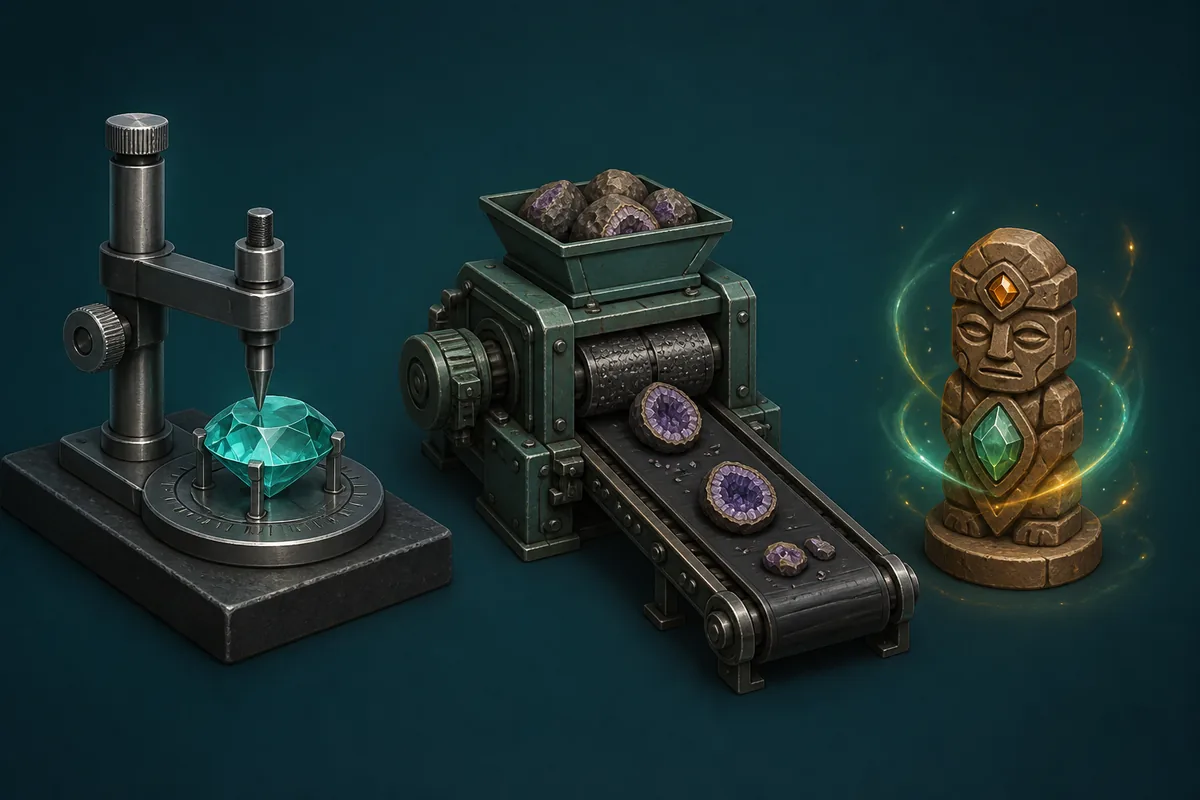
The official public game description confirms the ordinary production loop: place a grinder and conveyor, process geodes into gems, accept a buyer’s offer, and reinvest. It also says grinders continue producing while you are offline. That description is useful context for thinking about a future run, but it does not give a Rebirth cash requirement, a full list of items that reset, or a list of bonuses that persist. Those details are not safe to infer from the game’s general description.
Search results from fan guides currently discuss Rebirth, but they do not all agree on the exact threshold, the reset inventory, or the benefits. A number copied from a guide may belong to an earlier patch, a different account state, or an author’s own observation. Treat such claims as leads to check, not as official values. The most reliable evidence for your account is the current in-game menu and the warning shown immediately before a reset.
This page separates three kinds of information. A public game description is a first-party statement about the basic loop. A live menu or confirmation warning is account- and patch-specific evidence you can inspect now. A fan estimate is secondary reporting that may be useful but needs verification. Keeping those categories separate prevents an old threshold or assumed carry-over perk from turning into a costly surprise.
How to check the current Cut a Gem Rebirth requirement
How to check the current Cut a Gem Rebirth requirement
Start with the button or menu that is currently labeled for Rebirth in your game session. Menu names and layouts can change, so follow the live interface instead of a screenshot from a different update. Before opening a final confirmation, read the requirement displayed on the Rebirth screen and compare it with your current account. Check the unit and any conditions around it: a value might refer to wallet cash, lifetime progress, a prerequisite, or another displayed measure. Do not assume two similar-looking numbers mean the same thing.
Next, open the confirmation step only when you are ready to inspect it. Read the entire warning from top to bottom. Look for statements about cash, placed machines, inventory, geodes, totems, codes, unlocks, boosts, and anything described as permanent or retained. A detail that the dialog does not mention is unknown; silence is not proof that an item survives. If the text is abbreviated, unclear, or different from a guide you read, cancel and seek current evidence before continuing.
You can make the check reproducible with a short note. Record the date, the game version or update label shown in the experience, the displayed requirement, the exact warning language, and your own current values. If you use a screenshot for your personal notes, keep it private and do not present it as a universal rule. That gives you something concrete to compare after a patch or when another player reports a different result.
- Requirement — Copy the number and unit exactly as the live menu displays them.
- Reset warning — Note each item or balance the confirmation says will be removed, reduced, or preserved.
- Account state — Record your cash, equipment, inventory, totems, unlocks, and active boosts before confirming.
- Version context — Write down the date and visible update label so a later comparison has context.
- Unclear wording — Cancel if a consequential detail is missing or ambiguous; do not fill the gap with a guess.
Should you rebirth in Cut a Gem now or wait?
Should you rebirth in Cut a Gem now or wait?
A useful timing decision compares the value of another current-run upgrade with the cost and risk of rebuilding. It does not depend on one universal cash total. Ask whether the next purchase solves a real bottleneck, whether your production line reliably turns geodes into sellable gems, and whether the Rebirth screen shows a benefit you understand. If the menu gives no preview or leaves an important rule unclear, you do not have enough evidence to estimate the trade-off precisely.
Waiting can be sensible when you still need the current layout to learn how your machines fit together, when the next upgrade visibly improves a slow step, or when you have not read the reset warning. Rebirthing can be worth considering when the current line has stopped improving in a way you can observe, the live menu clearly shows what you gain, and you know how to restart production. These are decision signals, not claims about a hidden multiplier or guaranteed optimal timing.
Use the table as a practical gate. A single ‘ready’ signal should not override a warning that you do not understand. If two or more essential rows remain unknown, wait, gather evidence, or ask in the game’s official community channel rather than using an unsourced spreadsheet.
| Question | Rebirth may fit when… | Wait and verify when… |
|---|---|---|
| Current production | You can describe the slow step and your line runs consistently. | Your line is still being assembled or stops for a problem you have not diagnosed. |
| Next upgrade | The next purchase has a clear purpose and offers little improvement to the current bottleneck. | A known machine or layout fix would improve your current run. |
| Reset information | The live screen and confirmation explain the requirement and consequences you care about. | A currency, item, unlock, or boost is absent from the warning or described ambiguously. |
| Rebuild readiness | You know which first machines and geodes you will replace and can access them. | You have no notes, do not know where to restart, or rely on a promised carry-over claim. |
| Confidence | Your choice is based on visible game text and your own run data. | The only reason is a fixed number or reward copied from an undated guide. |
Record your Cut a Gem run before you reset
Record your Cut a Gem run before you reset
A small run log turns a vague ‘I think I was faster before’ into a comparison you can use. Before resetting, record a few observations that matter to your own workshop: how long it takes to restore a working conveyor, which purchase is your first meaningful upgrade, when your first gem reaches a buyer, and how much of the prior setup the game actually retained. You do not need to track every item or calculate an invented return-on-investment formula.
For example, suppose the current dialog clearly lists two reset consequences but says nothing about a particular totem. Do not write ‘the totem stays’ in your plan. Put that item in the unknown column, check its inventory state after the reset only if you decide to proceed, and update your note with what happened on your account. This is more useful than copying another player’s result without knowing their update or account conditions.
After a reset, keep the same simple observations for the new run. Compare like with like: time to a working line, time to the first sale, and the first bottleneck that returns. A difference may come from your changed layout or play session rather than Rebirth itself. Record the setup and session length so you do not mistake one short run for a general rule.
| Observation | Before reset | After reset |
|---|---|---|
| Requirement and warning | Date, requirement, and exact confirmation wording. | Note any change after an update or the next reset. |
| First working line | Machines and layout that reliably process one geode. | Time and steps needed to restore a working line. |
| First useful purchase | What removed the current bottleneck and why. | What you bought first and whether it solved the same issue. |
| Unknown carry-over | List items the warning did not clearly mention. | Mark only what you observed; leave other items unknown. |
| Session context | Time played, update label, and relevant boosts. | Use a similar play window before comparing progress. |
Plan your first rebuild session after Rebirth
Plan your first rebuild session after Rebirth
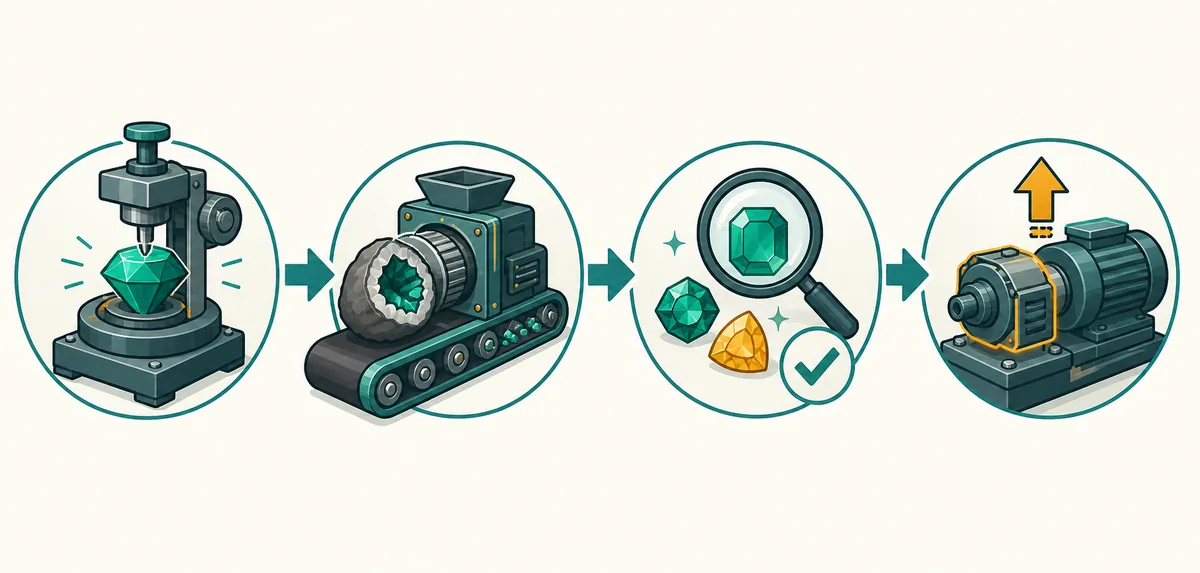
The official game description frames progress as a production loop: feed a geode into equipment, process it into a gem, accept a buyer’s offer, then reinvest. Use that loop to make a rebuild plan rather than trying to restore every detail of an old layout at once. First get one reliable path working. Then observe which step slows it down, fix that step, and expand only after the first line is producing consistently.
Before you reset, write down the first few actions you will take and the reason for each one. If you have previously made a simple conveyor layout that works, sketch it in your own notes. Keep the checklist flexible: the available cash, inventory, shop access, and bonuses after Rebirth may depend on current game rules. Recheck the menu and inventory instead of assuming your last run’s purchase order will still be possible.
Restore one working path
Place only the pieces needed to move a geode through a grinder and toward a buyer. Confirm that the line completes a cycle before adding branches or decorative parts.
Match the geode to the equipment you can access
Use the current shop and visible inventory. Choose an affordable geode that your available grinder can process; do not use an old tier list as proof that an item is unlocked on this run.
Watch the first few cycles
Check whether the machine receives input, whether the gem reaches the selling point, and whether the buyer interaction behaves as expected. This catches layout errors before you spend on another line.
Fix the measured bottleneck
If the line stalls at a particular step, change that step first. Compare the result over several cycles instead of assuming a purchase improved the whole factory.
Expand and test offline only after it is stable
Once the active loop works, add capacity in a way you can observe. The public listing says grinders keep running while you are offline, but test your own setup after a short absence before relying on a particular output rate.
How to handle changing Rebirth information
How to handle changing Rebirth information
Cut a Gem is updated over time, so a Rebirth requirement, menu label, or confirmation warning can change. This guide was reviewed on October 1, 2026. Recheck the live interface on the day you act and look for current developer announcements linked from the official Roblox experience. A search result’s publication or update date does not prove that every number inside it was re-tested after the latest change.
When you share a correction, include the date and update label, the exact wording you saw, and whether it appeared in the requirement screen or the final confirmation. Avoid posting account details or claiming that one observation covers every player. Until an official statement or repeated current evidence confirms a rule, this page will keep it marked as unknown rather than converting an anecdote into a universal fact.
Cut a Gem Rebirth FAQ
Cut a Gem Rebirth FAQ
How do I rebirth in Cut a Gem?
Use the Rebirth control shown in your current game session, review the displayed requirement, then read the entire final warning. This guide does not guess a menu path that may have changed; cancel if you do not understand what the warning says.
What are the Cut a Gem Rebirth requirements?
The current numeric requirement was not published in the official public game description checked for this guide. Read the live Rebirth screen for your account, including units and prerequisites, because an old guide may reflect another update.
What does Rebirth reset in Cut a Gem?
Do not assume a universal keep-or-reset list. Read the confirmation text for each currency, machine, item, unlock, totem, and boost you care about. If the dialog does not say, treat the result as unknown until you verify it in your session.
How much cash should I have before Rebirth?
There is no verified universal cash target in the public source checked here. Use the in-game requirement and warning, then decide whether you can rebuild a working production line with the resources you expect to retain.
When should I rebirth in Cut a Gem?
Consider it when you understand the live reset warning, can explain the current production bottleneck, and have a realistic first rebuild plan. Wait if a key consequence is unclear or the current setup still has an obvious fix.
Does this guide prove which items carry over?
No. It is a fan-made decision guide, not an official mechanic list. The public Roblox description does not document a complete Rebirth rule set, so use the live dialog and current developer announcements as the source for changing details.
A safer way to decide
A safer way to decide
The practical rule is simple: inspect the current requirement, read the final warning, record the details your account shows, and only reset when you understand the trade-off and know how you will restart production. The official public description confirms the grind-and-sell loop, not a fixed Rebirth threshold or a universal carry-over list.
Use your own run log to compare the time and steps needed to rebuild a working line. If the result differs from an older guide, trust the current in-game text for the action you are about to take and keep the difference dated. That creates a useful record without promising that one player’s patch or inventory applies to everyone.
Continue with the same-language guides for the parts of the workshop you plan to restore:
Sources and scope
Sources and scope
The official listing below supports only the public game loop described here. Third-party guides were reviewed to understand search-result coverage; their changing Rebirth claims are not treated as official confirmation.