
Updated September 2026
All Geodes in Cut a Gem: How to Compare Routes Without Guessing Drops
Looking for all geodes in Cut a Gem? The most useful answer is not a copied list with invented odds. Public information supports a workshop loop in which players handle geodes, run them through a grinder and conveyor, inspect the result, and decide what to test next. It does not currently give this guide a complete, current geode table with verified prices, drop rates, or a guaranteed best input. This page gives you a practical comparison method, explains what to record, and connects the general geode question to the separate Moss Crystal and Verdant Shards routes.
Quick answer
Quick answer
Treat every geode as a testable input, not as a guaranteed reward. First confirm the current experience, then record the visible geode name or type, purity if the game shows it, quantity, gear and machine state, completed grinder/conveyor cycle, exact result, buyer offer, and inventory status. Change one variable at a time. That is enough to compare your own runs and to spot whether a community claim is current. It is not enough to publish a fixed chance, price, or best-geode ranking without a dated source or repeatable in-game evidence.
What is verified about Cut a Gem geodes
What is verified about Cut a Gem geodes
The search phrase all geodes in Cut a Gem suggests a list intent, but a keyword signal does not prove that a public source has a complete list. The safe boundary is to separate the names you can see in the current Roblox experience from names repeated in old videos, reposts, or pages for another gem game. Keep Cut a Gem and Roblox in your notes so an unrelated geode system does not become a false entry.
The workshop loop is the useful stable layer. Public experience descriptions describe placing a grinder and conveyor, processing geodes into gems, accepting a buyer offer, and continuing production while the workshop runs. That supports a repeatable test environment. It does not verify a complete item table, a fixed purity multiplier, a machine bonus, a buyer price, or a guaranteed route to Moss Crystal, Verdant Shards, or any other named output.
Use three evidence levels. A source-backed fact has a URL and a check date. A session observation is something you can see in the current game, such as an exact result name or an offer. A community hypothesis is a lead about a geode, gear, totem, area, or collector level. Hypotheses are useful for choosing the next test, but they should stay labeled as unverified until the current experience or a dated first-party source confirms them.
Geode comparison table: what to record
Geode comparison table: what to record
This is the closest useful substitute for an unverified all-geodes list. Use one row per run, then compare like with like instead of ranking a geode from one lucky result.
| Field | Record | Useful for | Do not assume |
|---|---|---|---|
| Input identity | Exact geode name or visible type, quantity, session date | Keeping different inputs separate | That a color or nickname is an official category |
| Purity and appearance | Purity value if shown, visible modifiers, size or rarity label | Comparing similar inputs | That higher purity guarantees a named drop or profit |
| Workshop state | Gear, grinder, conveyor, upgrade state, completed cycle | Repeating a comparable test | That any upgrade has a documented geode bonus |
| Output | Exact result name, count, buyer offer, result panel | Checking what the current run produced | That one result proves a fixed drop rate |
| Inventory | Filters, capacity, collection tab, recent results | Finding an output that is easy to miss | That a missing item was deleted or removed |
| Evidence | Source URL, screenshot context, update date, failed checks | Deciding whether a claim is current | That an undated clip is an official guarantee |
Step-by-step geode route for a comparable test
Step-by-step geode route for a comparable test
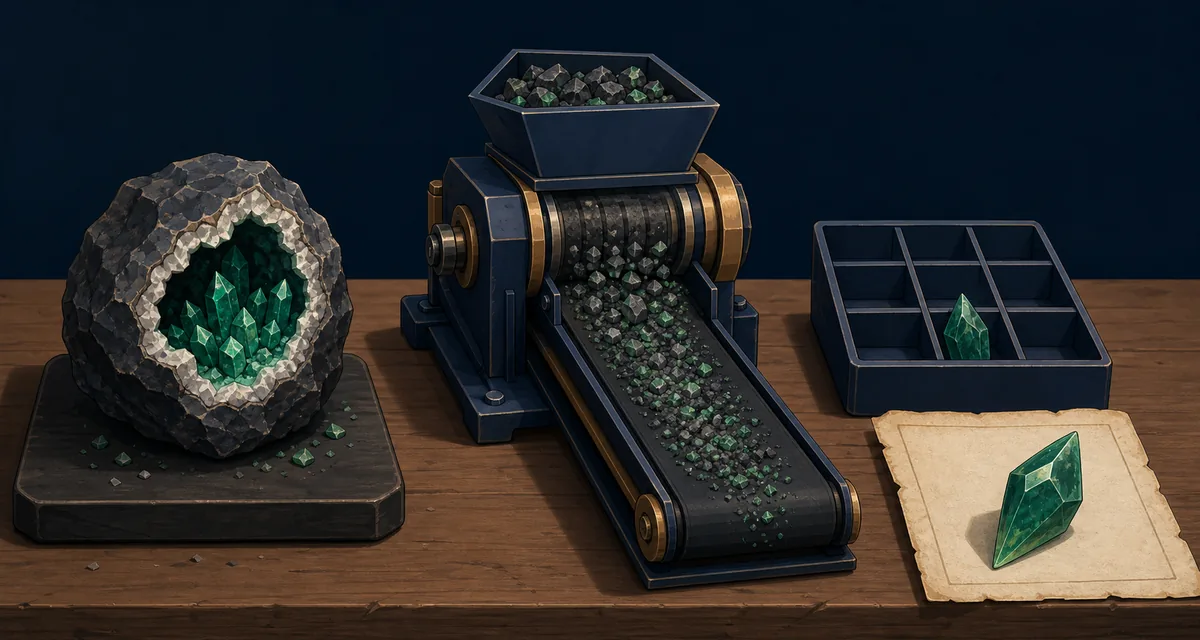
Run the steps in the same order. A consistent route makes a useful comparison possible even when the game does not publish a full table.
-
1. Confirm the current experience
Open the current Cut a Gem Roblox experience and wait for the workshop, geode controls, machine controls, and inventory to load. Treat an old video as a lead, not proof that the same route still works.
-
2. Choose one input
Select one geode or one visible geode category. Write down its exact name, quantity, purity if shown, and any modifier before you spend it. Do not mix two inputs in one conclusion.
-
3. Keep the machine state visible
Record the gear, grinder, conveyor, totem, and upgrade state that could affect the run. If a machine is still processing, wait for a completed cycle before judging the result.
-
4. Check the result and buyer offer
Read the exact result label, count, and buyer offer. A visual color is not enough to identify a named gem. Save the wording and the session date before starting another test.
-
5. Check inventory and collection
Search the exact item name in storage, collection, recent results, and any active filters. Capacity or a hidden category can make a successful run look like a failure.
-
6. Change one variable
For the next run, change only the input, machine state, area, gear, or session context. If you change everything at once, you cannot tell which claim the result supports.
How to compare purity and value without inventing a formula
How to compare purity and value without inventing a formula
Purity can be useful as a comparison field, but it is not automatically a profit formula. Record purity beside the input name, machine state, result, and buyer offer. If the game does not show a stable relationship, describe the observation instead of converting it into a multiplier. The same caution applies to rarity colors, gear bonuses, totems, and offline production.
A practical run log can answer a better question than “which geode is best?” Ask: which input produced a result I can verify, under which machine state, with what visible offer, and how repeatable was the observation? A geode that looks valuable but cannot be repeated may be less useful for planning than a lower-risk input with a clear output path.
Use the item-specific pages for narrower questions. Moss Crystal and Verdant Shards each have their own acquisition checks because a named output needs a separate evidence boundary. Use the Gear Guide for upgrade roles and the Codes page for volatile rewards. The geodes page is the comparison layer that connects those routes without claiming that one page has a hidden master table.
Why a geode result may differ
Why a geode result may differ
A different result does not automatically prove that a guide is wrong or that a geode was removed. Check the cheapest explanations first, then record the failed test.
- The source may describe a different Roblox experience, an old place, or a pre-update version.
- The geode name may be a nickname, a spelling variant, or a visual description rather than the exact in-game label.
- The grinder or conveyor may not have completed a comparable cycle, or the machine state may have changed.
- Inventory filters, storage capacity, collection tabs, or a closed result panel may hide the output.
- Gear, totems, area, input, and machine upgrades may have changed together, leaving no clean comparison.
- A community screenshot can show an observation without proving a fixed chance, price, collector requirement, or guaranteed route.
Cut a Gem geodes FAQ
Cut a Gem geodes FAQ
Is there a complete list of all geodes in Cut a Gem?
This guide does not claim that a complete, current public list is verified. Use the exact names visible in the current experience, record the date and input, and keep community-only names marked as unverified until a current source or repeatable game result confirms them.
How do I get geodes in Cut a Gem?
Start with the current workshop loop, choose the geode inputs available in your session, and process them through a completed grinder and conveyor cycle. Record the input and result instead of assuming that a video or a color label applies to every update.
What is the best geode in Cut a Gem?
There is no source-checked best-geode ranking in this guide. Compare purity, result, buyer offer, machine state, and repeatability for your own current session. A single lucky output is not enough to prove a universal ranking.
Does higher purity guarantee a better gem?
Not from the public evidence checked here. Purity is worth recording, but the page does not publish a verified formula connecting it to a guaranteed drop, price, or profit result.
Which geode gives Moss Crystal or Verdant Shards?
Use the dedicated Moss Crystal and Verdant Shards pages for their separate test routes. Neither should be converted into a fixed drop table unless a current source confirms the input, chance, and conditions.
Should I upgrade gear before testing geodes?
Use the Gear Guide to identify the current bottleneck, then keep the machine state consistent while comparing inputs. Do not assume that a more expensive upgrade has a named geode bonus without evidence.
Are the geode images on this page official screenshots?
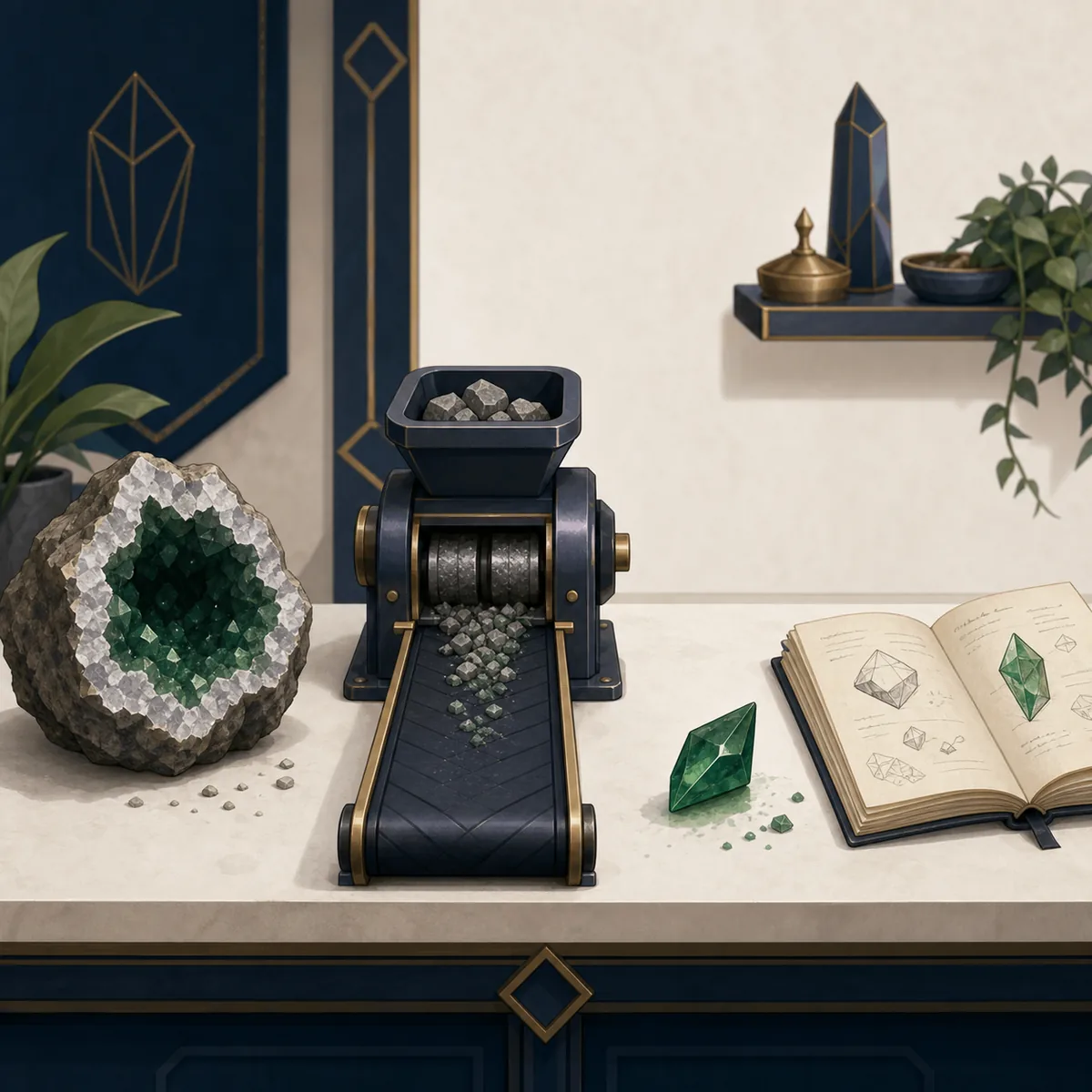
The feature image is an official Roblox thumbnail. The workflow visuals are editorial concept illustrations reused from the site and are explicitly not official Cut a Gem UI or drop-table screenshots.
Summary
Summary
For all geodes in Cut a Gem, the reliable starting point is a dated comparison log: exact input, purity if visible, machine state, completed cycle, result, buyer offer, and inventory check. The public workshop loop supports that method, but the checked sources do not support an invented master list, fixed odds, price table, profit formula, or best-geode guarantee.
Use this page as the geode comparison layer. Follow the Gear Guide for upgrade roles, the Moss Crystal and Verdant Shards pages for item-specific routes, and the Codes page for reward status. When a new update changes the experience, a clear test record is easier to refresh than a confident number with no source.
Keep the general geode comparison separate from item-specific routes and volatile rewards so each page answers one question clearly.
Return to the Cut a Gem Roblox Guide
Compare the Moss Crystal route
Sources and limits
Sources and limits
These references support the experience identity, public workshop context, and editorial boundary. They do not establish an official all-geodes drop table.